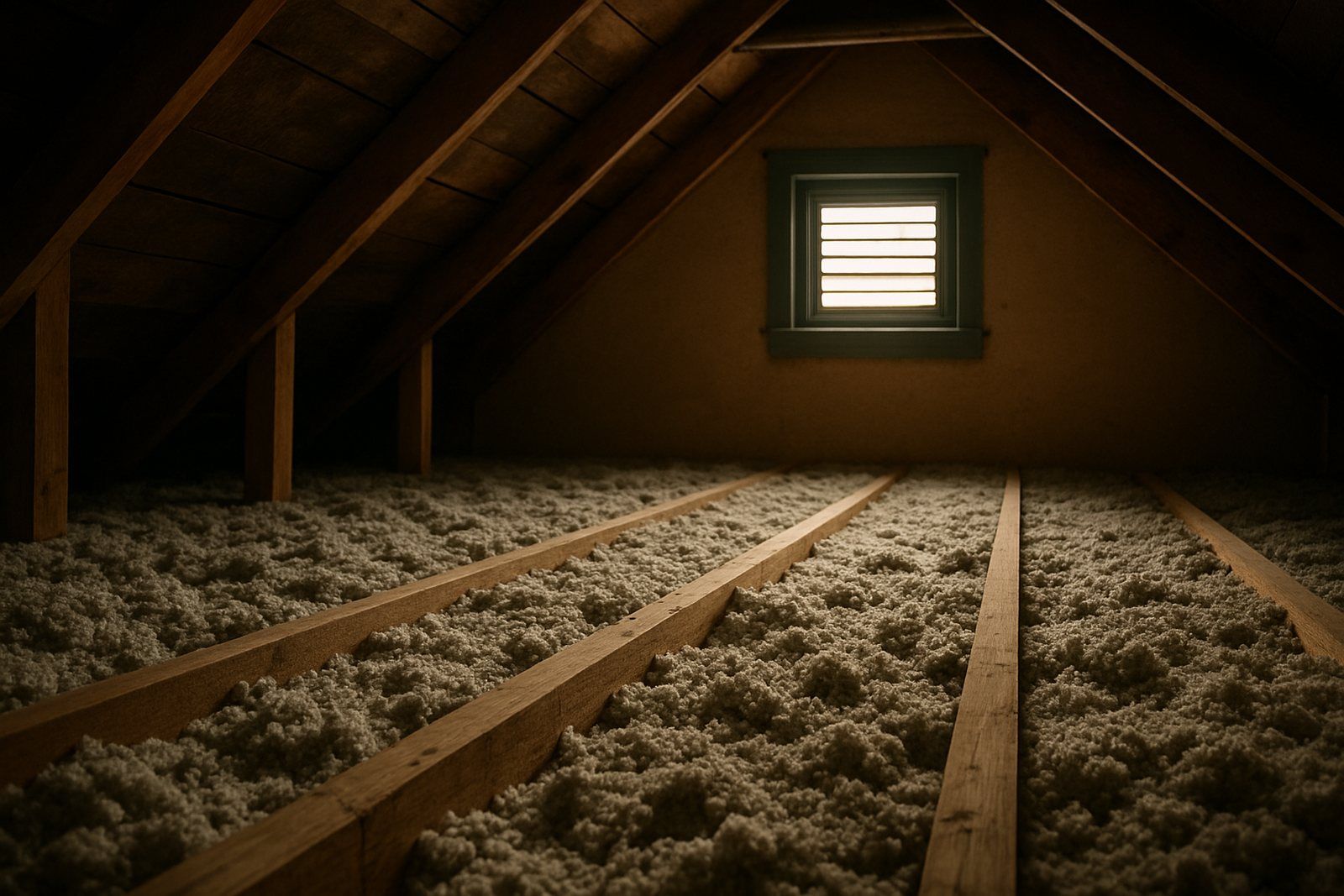
Insulation & air sealing
Attic Insulation Guide: How Much R-Value You Need and What It Costs
How much attic insulation you need by climate zone, how to check what you have, which material to choose, DIY vs pro, and why to air seal first.
Topics
How much could more insulation cut your heating bill? Enter the area, your R-value before and after, your local heating degree days and fuel price to estimate yearly savings and payback.
Updated · Free, private: nothing you type leaves your browser.
Your results
Going from R-11 to R-49 over 1,200 sq ft could cut heating costs by about $152 a year, paying back in about 13.1 years.
Estimate only. Uses the assumptions explained below.
| Yearly heating cost through this area | |
|---|---|
| Now (R-11) | $196 |
| After (R-49) | $44 |
| Year | Running total |
|---|---|
| 0 | −$2,000 |
| 1 | −$1,848 |
| 2 | −$1,695 |
| 3 | −$1,543 |
| 4 | −$1,391 |
| 5 | −$1,239 |
| 6 | −$1,086 |
| 7 | −$934 |
| 8 | −$782 |
| 9 | −$629 |
| 10 | −$477 |
| 11 | −$325 |
| 12 | −$173 |
| 13 | −$20 |
| 14 | $132 |
| 15 | $284 |
| 16 | $437 |
| 17 | $589 |
| 18 | $741 |
| 19 | $893 |
| 20 | $1,046 |
| 21 | $1,198 |
| 22 | $1,350 |
| 23 | $1,502 |
| 24 | $1,655 |
| 25 | $1,807 |
| 26 | $1,959 |
| 27 | $2,112 |
| 28 | $2,264 |
| 29 | $2,416 |
| 30 | $2,568 |
| Year | Energy savings | Net cash flow | Running total |
|---|---|---|---|
| 0 (Up-front cost) | — | −$2,000 | −$2,000 |
| 1 | $152 | $152 | −$1,848 |
| 2 | $152 | $152 | −$1,695 |
| 3 | $152 | $152 | −$1,543 |
| 4 | $152 | $152 | −$1,391 |
| 5 | $152 | $152 | −$1,239 |
| 6 | $152 | $152 | −$1,086 |
| 7 | $152 | $152 | −$934 |
| 8 | $152 | $152 | −$782 |
| 9 | $152 | $152 | −$629 |
| 10 | $152 | $152 | −$477 |
| 11 | $152 | $152 | −$325 |
| 12 | $152 | $152 | −$173 |
| 13 | $152 | $152 | −$20 |
| 14 | $152 | $152 | $132 |
| 15 | $152 | $152 | $284 |
| 16 | $152 | $152 | $437 |
| 17 | $152 | $152 | $589 |
| 18 | $152 | $152 | $741 |
| 19 | $152 | $152 | $893 |
| 20 | $152 | $152 | $1,046 |
| 21 | $152 | $152 | $1,198 |
| 22 | $152 | $152 | $1,350 |
| 23 | $152 | $152 | $1,502 |
| 24 | $152 | $152 | $1,655 |
| 25 | $152 | $152 | $1,807 |
| 26 | $152 | $152 | $1,959 |
| 27 | $152 | $152 | $2,112 |
| 28 | $152 | $152 | $2,264 |
| 29 | $152 | $152 | $2,416 |
| 30 | $152 | $152 | $2,568 |
| Total | $4,568 | $4,568 | $2,568 |
Save up to 3 scenarios (for example, with and without a rebate) and compare them side by side.
Heat flows out through your ceiling, walls and floors whenever it is colder outside. How fast it flows depends on the area, the R-value, and the temperature difference. The calculator estimates the heat you stop losing over a winter when you raise the R-value, then turns that into fuel and dollars.
U-value (heat flow rate)  = 1 ÷ R-value
Heat saved per season     = area × (1/R before − 1/R after) × heating degree days × 24
Fuel saved                = heat saved ÷ (BTU per unit of fuel × system efficiency)
Yearly savings            = fuel saved × fuel price
Simple payback (years)    = project cost after rebates ÷ yearly savings
Heating degree days (HDD) stand in for “how cold, for how long.” In the U.S., each day’s count is the number of degrees its average temperature falls below 65°F, added up over the year, according to EIA’s degree-day explainer. Multiplying by 24 turns degree days into degree hours, which matches U-values given per hour.
Fuel energy content comes from EIA: 100,000 BTU per therm, 91,452 BTU per gallon of propane and 3,412 BTU per kWh. The tool uses 137,381 BTU per gallon for heating oil.
Default prices are dated EIA averages: natural gas about $1.35 per therm (residential, January 2026), propane $2.638 and heating oil $6.138 per gallon (week of October 12, 2026, before taxes), and electricity 18.31¢ per kWh (July 2026).
The tool treats the area as a single surface with a uniform R-value. It does not model air leaks or framing.
The default case is a 1,200-square-foot attic floor in a place with 5,000 heating degree days, heated by a 90% efficient natural gas furnace with gas at $1.35 a therm.
A colder home with 6,500 heating degree days heats with propane in an 85% furnace, at $2.64 a gallon. Its 1,000-square-foot attic is close to uninsulated, about R-3, and will be brought to R-38 for $2,500.
The difference is mostly the starting point. Insulating a nearly bare attic in a cold place with a pricey fuel is often among the best-paying home upgrades.
| Starting point | Typical effect of adding insulation |
|---|---|
| Little or none (about R-3 to R-11) | Large heating savings; payback often short |
| Moderate (about R-19 to R-30) | Smaller but real savings; payback longer |
| Already near ENERGY STAR target | Small savings; focus on air sealing instead |
The dollar figure is the heating cost you could avoid through that one surface in a typical winter. A short payback means the project is likely worth doing on cost alone. A long payback does not mean “don’t do it”: insulation keeps working for many years, and it also makes rooms less drafty and helps a heat pump or furnace keep up.
If you are not sure what R-value you have, the attic insulation calculator estimates it from depth and material, and shows the inches needed to reach the ENERGY STAR level for your zone. For a payback that includes rising energy prices over 20 or 30 years, use the energy efficiency payback calculator.
Climate. Degree days drive the result. The same project saves far more in Minnesota than in Georgia. Use local data from NOAA’s Climate Prediction Center or your utility rather than a national guess.
Air sealing. Insulation slows heat flowing through materials; it does not stop air leaks. ENERGY STAR recommends sealing first, and EPA estimates sealing plus insulating saves an average of 15% on heating and cooling. Our air sealing guide and attic insulation guide explain the order of work.
Incentives. There is no federal tax credit for insulation installed in 2026; 25C ended for property placed in service after December 31, 2025. Some state-run Home Energy Rebate programs pay for insulation and air sealing, and DOE Program Notice 26-2 requires households to address insulation and air sealing before appliance rebates unless the home already meets a state-set level. The Weatherization Assistance Program provides free work for income-eligible households. Our energy bill assistance guide covers how to apply.
This is a steady-state heat loss estimate for one surface. It ignores air leakage, framing (thermal bridging), solar gain, internal heat from people and appliances, and how your heating system behaves at part load. It covers heating only, with no cooling savings. Real savings can differ. This is an educational estimate, not a quote or advice. Get at least three written quotes, and consider a professional energy audit that measures air leakage.
It depends on how much you have now. Going from very little insulation to a recommended level saves the most; adding more on top of a well-insulated attic saves much less. EPA estimates that air sealing plus adding insulation in attics, floors over crawl spaces and basements saves an average of 15% on heating and cooling costs. This calculator estimates the heating part for one surface, using your area, R-values, climate and fuel price.
Heat loss depends on 1 divided by R-value, not on R-value itself. Going from R-3 to R-38 cuts heat flow through that surface by most of what it was. Going from R-30 to R-60 halves a heat flow that was already small. That is why the first few inches pay back fast, and the last few take much longer. Enter your real starting R-value to see this in your own numbers.
Heating degree days measure how cold a place is over a season. In the U.S., each day's count is how many degrees its average temperature falls below 65°F, added up over the year. Colder places have more. NOAA's Climate Prediction Center publishes degree-day tables by city and state, EIA explains the measure, and some utilities print degree days on the bill.
An attic ceiling with no insulation has a very low R-value, roughly R-2 to R-3, which is the rough hint built into the tool. To estimate an attic that has some insulation, measure its depth and multiply by about 2.5 per inch for loose-fill fiberglass, 3.7 for cellulose, 3.2 for fiberglass batts or 2.8 for rock wool, the rough figures ENERGY STAR uses.
No. The calculator covers heating only, which is the larger share of insulation savings in most of the country. Better attic insulation also slows summer heat gain, so homes with central air will usually see some cooling savings on top. In hot southern climates, cooling savings can matter as much as heating.
Often yes, because insulation has no moving parts, needs little upkeep and also makes rooms more comfortable. A payback of 10 to 15 years can still be a good deal on something that keeps working for many years. Use the payback calculator to add rising energy prices over the life of the upgrade, and check utility and state programs that may lower your cost.
This calculator gives educational estimates, not quotes, tax advice or an eligibility decision. Results depend on the inputs and assumptions shown above. How we research
How much attic insulation you need by climate zone, how to check what you have, which material to choose, DIY vs pro, and why to air seal first.
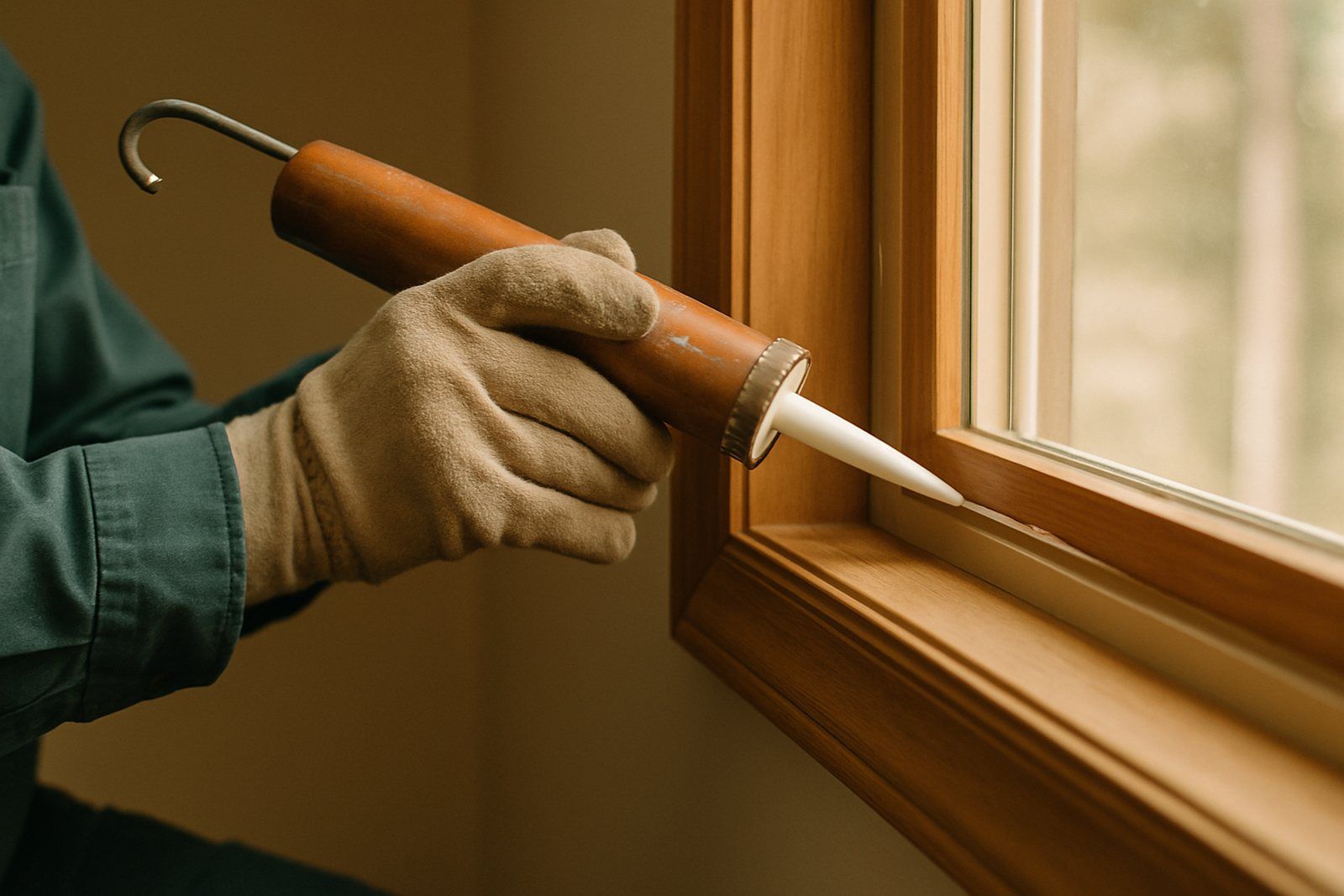
Where homes leak air, how to find leaks, what a blower door test shows, DIY caulk and weatherstripping, attic bypasses, and combustion safety.